Coaching Informed by the Biozygotic Framework
Coaching conversations grounded in an integrative view of psychosomatic life — drawing on Positive Psychotherapy, Zubirian philosophy, and embodied neuroscience — to help you reflect on the pressures shaping you and consider where rebuilding capacity might be possible.
Coaching is not psychotherapy and not a substitute for medical or mental-health care. For clinical concerns — including significant depression, anxiety, trauma symptoms, or any condition under active treatment — please continue working with a qualified licensed professional.
What Makes This Approach Different?
Many coaching styles treat the mind as an isolated engine of willpower — if you just think clearly and set the right goals, change will follow. But willpower is biologically expensive, and the body that generates it is shaped by history, environment, and cumulative stress. Mindfulness-based and somatic-focused approaches recognize this; the Biozygotic Framework brings them into one integrative lens.
A Structured Lens, Not a Diagnostic Score
The framework offers a structured way to consider where the strain is sitting — physical exhaustion, mental dissipation, narrative fragmentation, environmental drag, or some combination. This isn't a diagnostic tool; it's a shared vocabulary for thinking together about what's actually going on and where movement may be possible.
Integration Over Fragmented Fixes
Wellbeing isn't built by addressing one thing at a time in isolation. Sessions consider how nervous-system regulation, biographical reflection, daily practices, relationships, and meaning-making interact — and where a small change in one area may ripple usefully through others.
Meet Your Coach
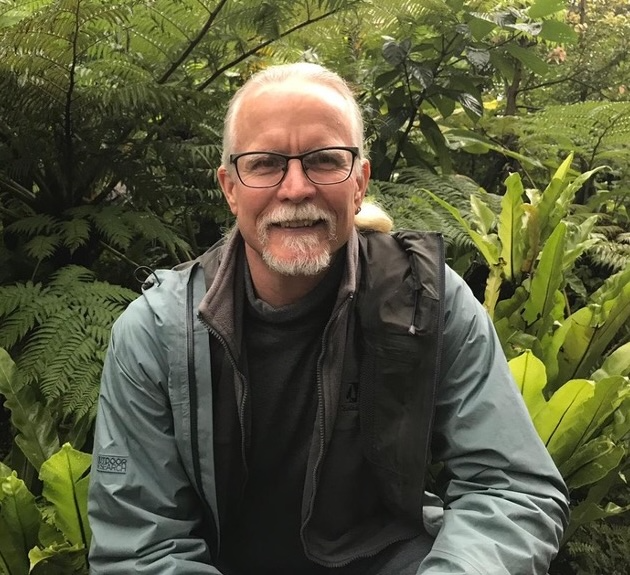
Theo A. Cope, PhD, Psychotherapist
Founder of The Biozygotic Framework™
Theo A. Cope holds a MA and PhD in Psychology. He is a certified Positive Psychotherapist (PPT after Peseschkian, 1977™) & Counselor with over 20 years providing support, and transitioned into education & coaching. From 2014–2017 and 2018–2022, he worked as a Psychotherapist in a private hospital in Beijing, China, serving as Head of the Mental Health Department at Raffles Hospital for his final two years. He has also worked with Calm International as a therapist.
Dr. Cope has worked with people — ages 8–78 — from over 50 countries, with diverse backgrounds and goals including: goal-setting, time management, self-actualization, depression, anxiety, adjustment disorders, eating disorders, self-harm, cross-cultural relationships, major life transitions, and works with individuals, couples, groups, and families. He is also a certified "Stress Surfing" instructor using the model of Dr. Ivan Kirillov.
Personal statement: I strive to bridge the gap between rigorous philosophical theory (Zubiri), intercultural psychotherapy, mindfulness practices, and embodied neuroscience. Building on the mathematics of John Gottman — from The Mathematics of Marriage — the BZE was developed to assist individuals who have found dualistic approaches insufficient and are open to a more integrative stance.
Supporting and empowering you and your social-psychosomatic wellbeing. My coaching style is pragmatic, analytical, empathetic, and grounded in the reality that our bodies and our histories are constitutively entangled. I work with clients to enhance their skills, map their specific structural challenges, understand their personal life history and its impact on wellbeing, and build sustainable, integrated capacity for their goals.
Conceptual Tools of This Coaching
Different traditions inform the practical shape of the work: Peseschkian's balance model from Positive Psychotherapy (PPT after Peseschkian, since 1977), and Siegel's interpersonal neurobiology, CBT, DBT, and other mindfulness-based applications. Together they give the coaching its working vocabulary for what integration looks like and where agency becomes available.
Peseschkian's model identifies four life domains that every person navigates continuously, often with one or two dominating attention while others may be undeveloped. Coaching work examines how your energy is currently distributed across them — and where rebalancing would increase overall capacity.
- Psycho-physical (Ψ ⊗ O): Psychological and physical energy, emotional regulation, physiological and metabolic conditions.
- Fantasy: Focus on meaning, needs/values, ideals, future hopes, dreams, and fears.
- Productivity (Achievements): Understanding, planning, and acting step-by-step.
- Relationship: Getting support, help, information, and encouragement.
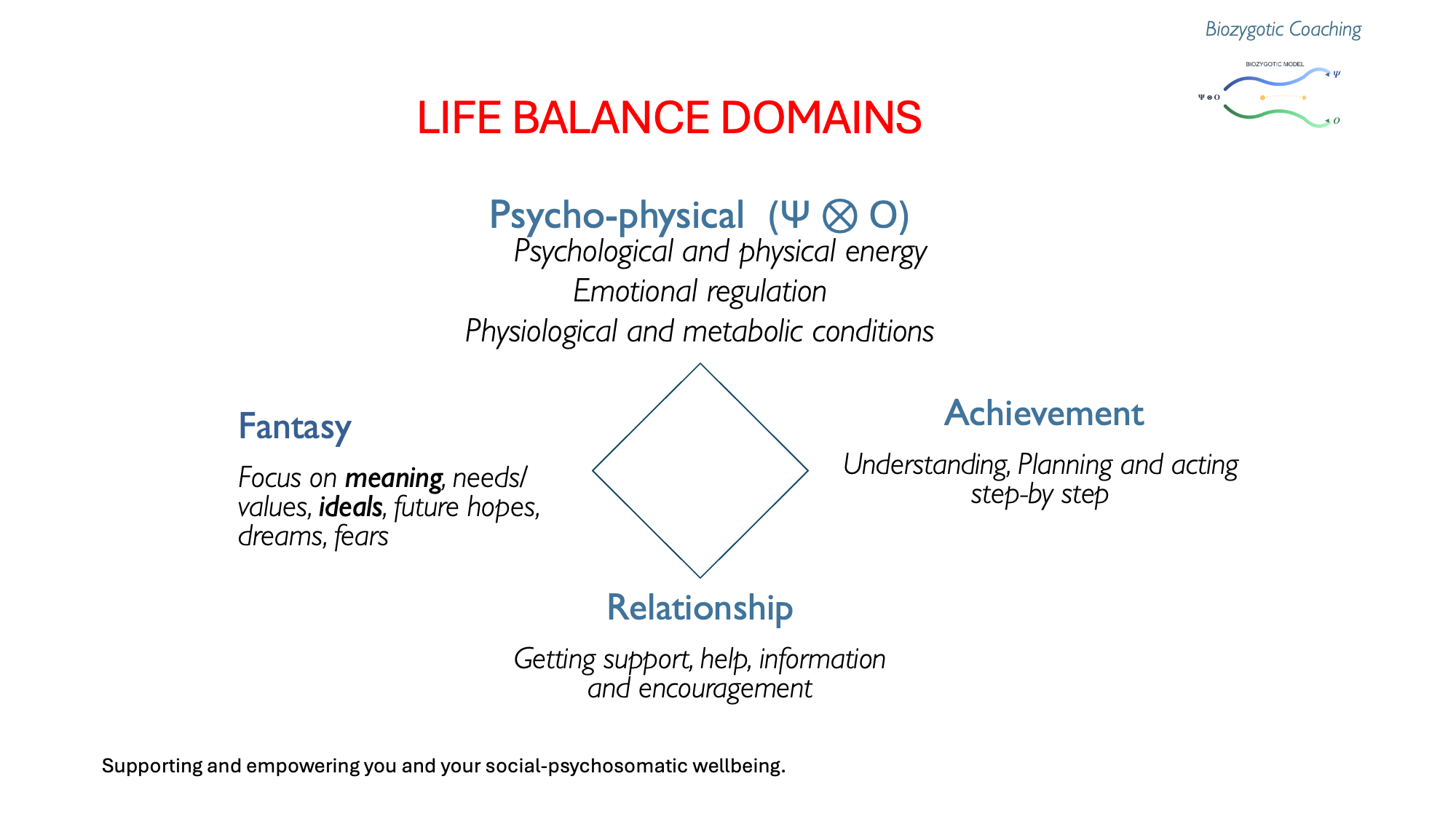
Supporting and empowering your social-psychosomatic wellbeing.
Two further visual anchors inform the work: Siegel's mind-triangle and his window of tolerance. The first names what regulation looks like as a process; the second names the zone of arousal in which agency is actually available.
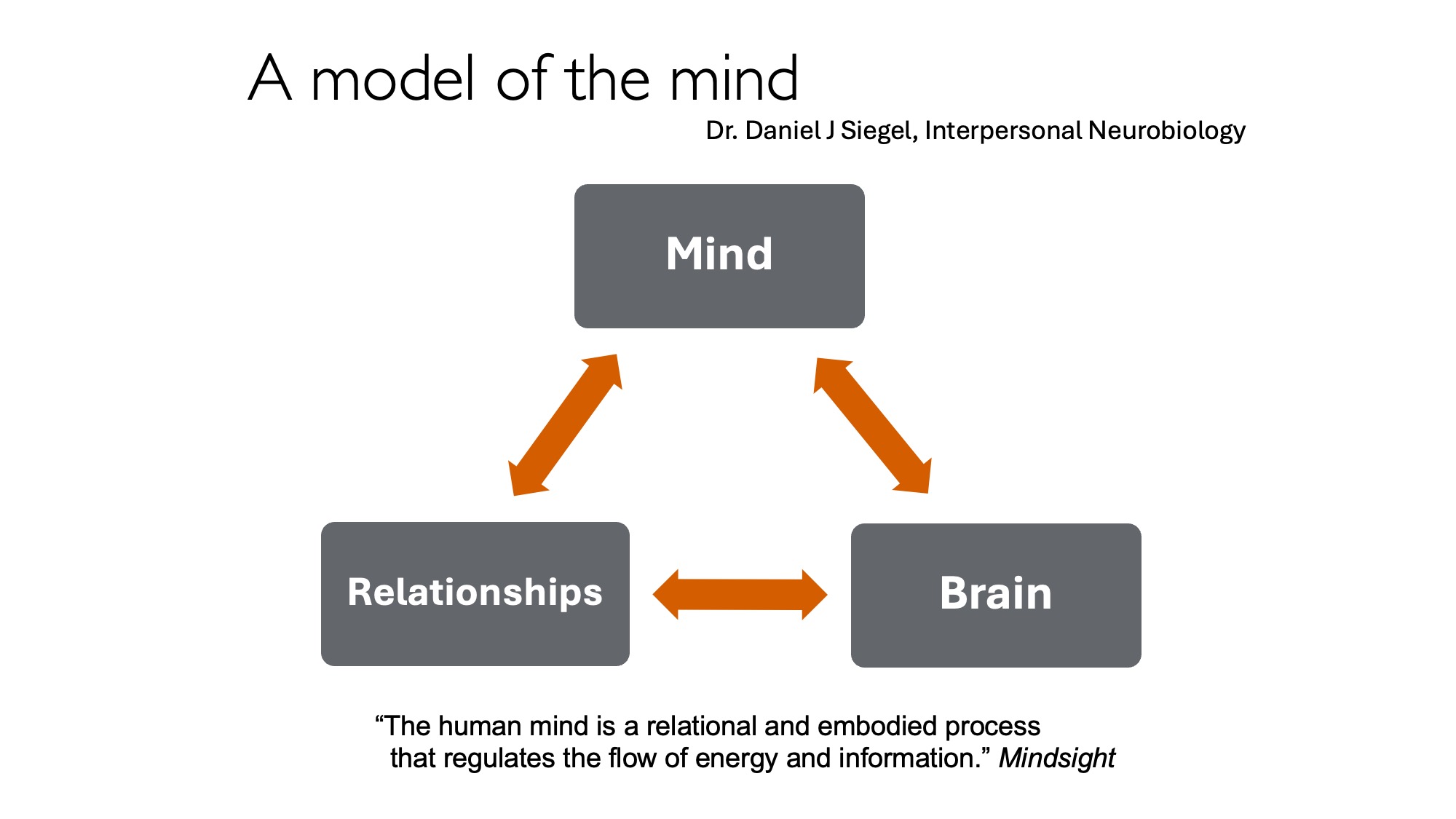
Figure 1: Siegel Mind-Triangle
Emergent self-organizing process that regulates the flow of energy and information.
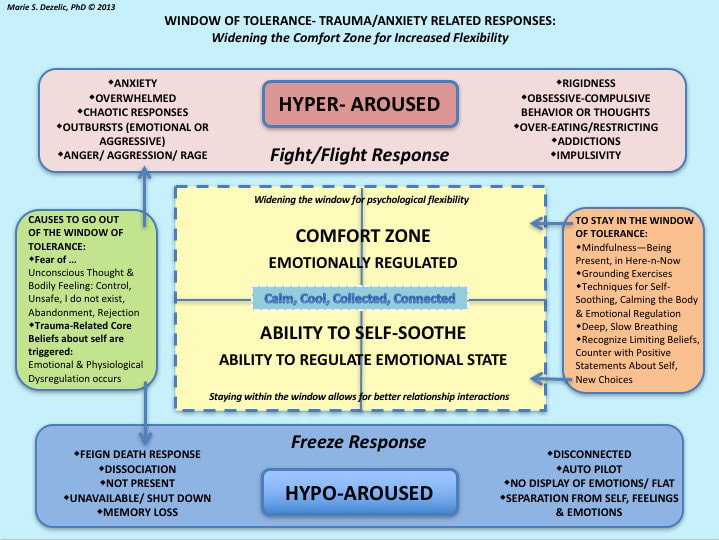
Figure 2: Window of Tolerance
Optimal zone for efficient spatiotemporal processing and identity retention force; based on Dan Siegel's work.
The Coaching Process
What follows describes the general shape of the work. Every person is different, and the actual sequence and pace emerges through conversation rather than fitting a fixed protocol.
Orienting Conversation
We begin by getting to know your situation — what's pressing, what's working, what's depleted, and what you're hoping coaching might support. The framework offers a vocabulary for considering how different dimensions of your life interact, used to support shared understanding rather than impose a label.
Finding the Pressure Point
Rather than trying to fix everything at once, we look for where the strain seems most load-bearing right now — whether that's somatic depletion, mental dissipation, narrative disruption, or environmental pressure — and where change might have the most reach.
Practical Integration
Coaching then focuses on practices and reflections you can carry into daily life — drawing as needed on nervous-system regulation, biographical reflection, the Peseschkian balance model, and other approaches — building gradually rather than demanding dramatic overhaul.
Considering Coaching?
Sessions are conducted via secure video conference. Availability is limited to ensure careful attention to each person's situation. The first conversation is exploratory — a chance to see whether this approach fits what you're looking for, with no obligation to continue.
Inquire About Availability