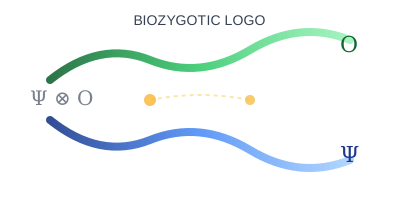
Ψ The Flow of Psyche
The flowing blue line captures the dynamic temporal stream of psychological experience — drawing on Xavier Zubiri and his influence from the American phychologist & philosopher, William James. Emergent, subjective, biographical.
O The Stable Substrate
The slower flowing green line is the soma — the biological and structural anchor. The dynamic metabolic and neurological foundation from which psyche springs forth. Rooted, flowing slower & simultaneously rapidly...bones, muscles, nerves or chemicals.
Both streams diverge from, and continuously interact within, a single tensor singularity (Ψ ⊗ O).
The Problem: The Mind-Body Split
For centuries, science has split the human person, treating the body as a biological mechanism and the mind as an unmeasurable artifact. While Darwin anchored our early emotional evolution, and pioneering theorists like Freud and Jung centered their clinical models on the unconscious psyche, modern disciplines largely abandoned the term. Medicine reduced it to neurochemistry, while empirical psychology favored terms like "behavior," "cognition," or "consciousness." Consequently, psyche has been left vague—relegated to myth, conflated with the mind, translated as soul, or projected as a spiritual fill-in. This work is premised on humans being psycho-somatic systems, substantivities of psyche with body-brain. I'm a psychotherapist, now doing coaching. Here is what I mean by the term:
The psyche is the sentient dimension of a living organism — that structural aspect of the whole organism through which it feels, apprehends, and responds to what surrounds it, as a genuine, co-determining note of the single psycho-organic system that it is. Psychic life may present across the animal world wherever living matter is sufficiently organized to give rise to genuine sensing. In humans, the psyche is distinctively intellective: it orients the organism toward reality as reality, not merely as stimulus, grounding the distinctively human capacity to take charge of its own reality, of one's own life to the degree we can and do.
The psyche has its own reality and its own causal efficacy within the substantivity, yet it is not a substantivity in itself: it cannot exist apart from the organism, and the organism cannot exist apart from it. It is not a soul housed within a body, not a mind running on neural hardware, not an emergent property atop biology — it is the sentient dimension of the organism's life itself, present from conception and unfolding developmentally through the biography of the person.
Psyche is not identifiable with the brain or any single organ, though it is not independent of them. The brain is the organ through which the organism's sentient capacities are differentiated and operationalized — the architecture that makes specific senses, integrative capacities, and eventually intellective function possible. In the framework's shorthand: DNA codes the brain-body unity; neurology differentiates the capacities of psyche. The psyche itself is the sentient dimension of the whole psycho-organic system, of which the brain is the principal organ of articulation.
Distinct from psyche as structure is psychism: the actual exercise and activity of psychic capacities, which develops through successive modes — passive in early life, increasingly actional as the organism matures — and which is what clinical and empirical work principally engages.
You do not just have a psyche. You structurally are a psychosomatic unity.
For technical definitions of terms and notation used throughout, see the Glossary.
The Biozygotic Equation (BZE)
Hover over the symbols to explore the framework.
The tensor product of Psyche and Soma. Distinct dimensions of a single structural system.
Not deterministic. This gap preserves your freedom, novelty, and capacity to choose.
Your biography. The framework proposes that experience leaves structural traces across biology — not as deterministic storage but as accumulated patterning.
The context of your specific environment.
Structural factors that either absorb life's shocks or multiply them violently.
The irreducible, unpredictable randomness of living in the real world.
In plain language this is a philosophical claim: Who you are as a unified person (Ψ ⊗ O) is the result of your lifelong biography (Σ(B)), conditioned and amplified by the safety or violence of your environment (σ · ξ).
What Is BZE?
The Biozygotic Equation (BZE) is a developing theoretical framework that articulates the inseparable unity of psyche and soma — what Xavier Zubiri (1898-1983) called "psychosomatic substantivity" (a unified, unique system) — and uses schematic mathematical notation to express the structural relationships at stake. Rather than treating emotional and physical health as separate domains, the framework considers them as constitutionally coupled dimensions of a single living reality.
This is not a deterministic formula (note the ≅, not =). The notation preserves human freedom while inviting consideration of measurable constraints on affective and physical health.
Critical Distinction: The symbolic expression articulates what the framework is thinking about (the nature of psychosomatic unity). The mathematical notation indicates structural relationships within the framework; fully operationalizing these relationships into validated empirical measures is ongoing work, not delivered apparatus.
Why Another Framework?
Consider what most frameworks offer a suffering person. In contemporary life, the dominant options run roughly: you are a brain whose chemistry has gone wrong; a mind whose thoughts need correcting; a body holding trauma; a self that needs to actualize; a soul on a journey; a product of social systems; a meaning-making creature who must construct significance.
Each does real work for the people who inhabit it. Each also fails in specific ways when pressed:
- The brain framework cannot account for why meaning matters.
- The mind framework cannot account for why insight fails to change the body.
- The trauma-body framework cannot account for why concepts matter.
- The self-actualization framework cannot account for why people are constituted by forces they didn't choose.
- The social-systems framework cannot account for why two people in the same conditions respond differently.
Each is doing partial work on a single reality none of them is adequately naming. Integrative approaches in coaching and clinical practice are common. The Biozygotic Framework offers the architecture that holds them together: a psycho-organic substantivity whose life is lived through all these dimensions at once. The mathematical architecture below indicates how this holding-together can be articulated more precisely as the framework develops.
Mathematical Architecture
The Biozygotic (BZ) model is the developing mathematical companion to the framework — schematic equations expressing how biological substrate and biographical persistence are proposed to relate.
The State Evolution Equation (Schematic)
Current Research Status
The model is currently a theoretical framework. Parameters are derived from established principles in psychotherapy, philosophy, and spatiotemporal neuroscience; specific weightings represent a formal hypothesis. The mathematical structure itself remains under active refinement and requires sustained collaboration with mathematicians to advance beyond schematic form.
Research Directions: Qualitative synthesis now; future phases would aim to correlate framework constructs with established empirical measures — HRV-derived vagal tone, DMN connectivity patterns, allostatic load indices, longitudinal clinical outcomes — in collaboration with empirical researchers.
The BZE: A Way of Thinking About You
This isn't a personality test or a diagnostic instrument. It's a structured way to think about whether you have enough capacity — physical and psychological — to engage your own life as you'd like to, or whether your environment is running you down faster than you can rebuild. The framework offers a lens for considering which dimensions may be supporting you and which may be carrying strain.
Why the Coupling Matters
Many psychological tools simply add scores together. The framework instead foregrounds coupling. Because psyche and body are constitutionally linked, if physical capacity is severely depleted, the framework would predict that the whole system's capacity is compromised — you cannot simply "think" your way out of a biological deficit. The math expresses this conceptual relationship rather than calculating a specific outcome.
Your Reflection Synthesis
The reflection invites you to consider whether you have room to grow — or whether you are in survival mode. First, you answer three quick questions about how your nervous system tends to operate, so the framework's lens is oriented to your particular nervous-system patterns rather than to an average person.
The Four Pillars of Capacity
Philosophical Grounding: Xavier Zubiri
Xavier Zubiri proposed that the psyche and soma are not separate substances, but interdependent "notes" of a single system — a substantivity. For embodied life, one cannot exist without the other; they are constitutively entangled. His framework is primarily a philosophical anthropology focused on human psychosomatic structure, with particular emphasis on the human intellective psyche. The BZE extends Zubiri's philosophical anthropology into an applied framework for clinical and research psychology.
The psyche's function is to "take charge" (hacerse cargo) of the organism's relationship with reality as such. This "taking charge" means:
- Behaving in relation to things not only by their properties but by their character of reality
- Apprehending things as real stimuli, not merely as stimulating
- Relating to oneself as reality, not merely as stimulus-response mechanism
- Possessing a mode of being (personhood) distinct from mere substantive reality. In order to persist, we must act 'as if' things are real — even if philosophically one believes they aren't. We really need to take care of our bodies. You know that a vehicle coming towards you really could hurt if it hits!
In the framework, Zubiri's concept of brotar (to spring forth) finds a contemporary resonance in Mitochondrial Psychobiology (following Martin Picard's work). The framework proposes that biography is, in important ways, structurally registered in the cellular energy networks that allow psyche to maintain its integrity through somatic energy.
The Role of Agency: The BZE is not a deterministic trap. While we cannot fully control all environmental noise ($dW_t$) or erase our early biographical history (Σ(B)), human agency exists in our capacity to actively modulate our own system. Through deliberate somatic regulation and narrative integration, a person actively "takes charge" by increasing psycho-physical coupling capacity, mind-body awareness and reducing their systemic dissipation lost to the intrusions of past memory-states. We are, within the constraints that shape us, the architects of our own equation.
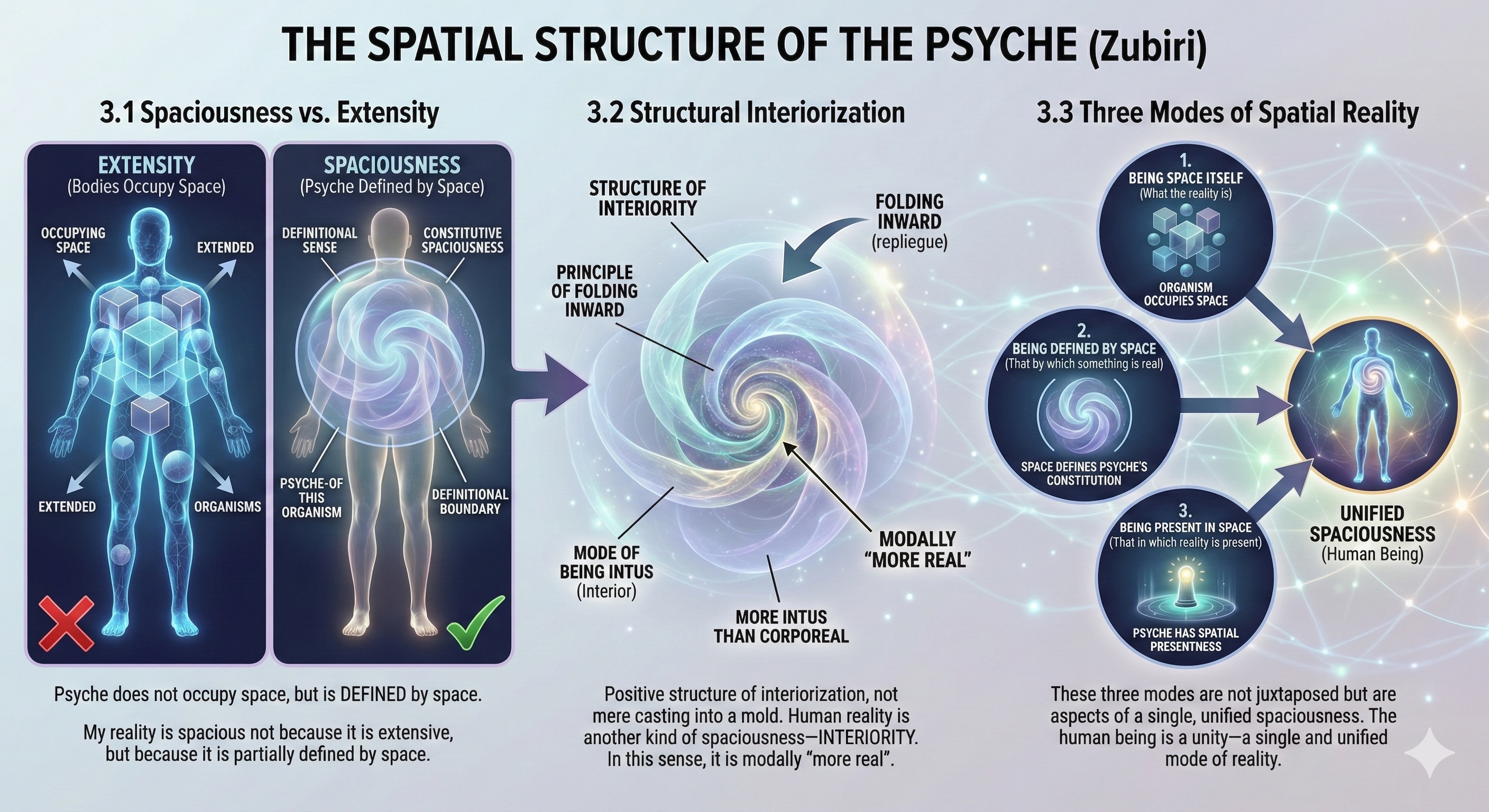
Fig 3: Spatiality — Topological entanglement with spatial things.
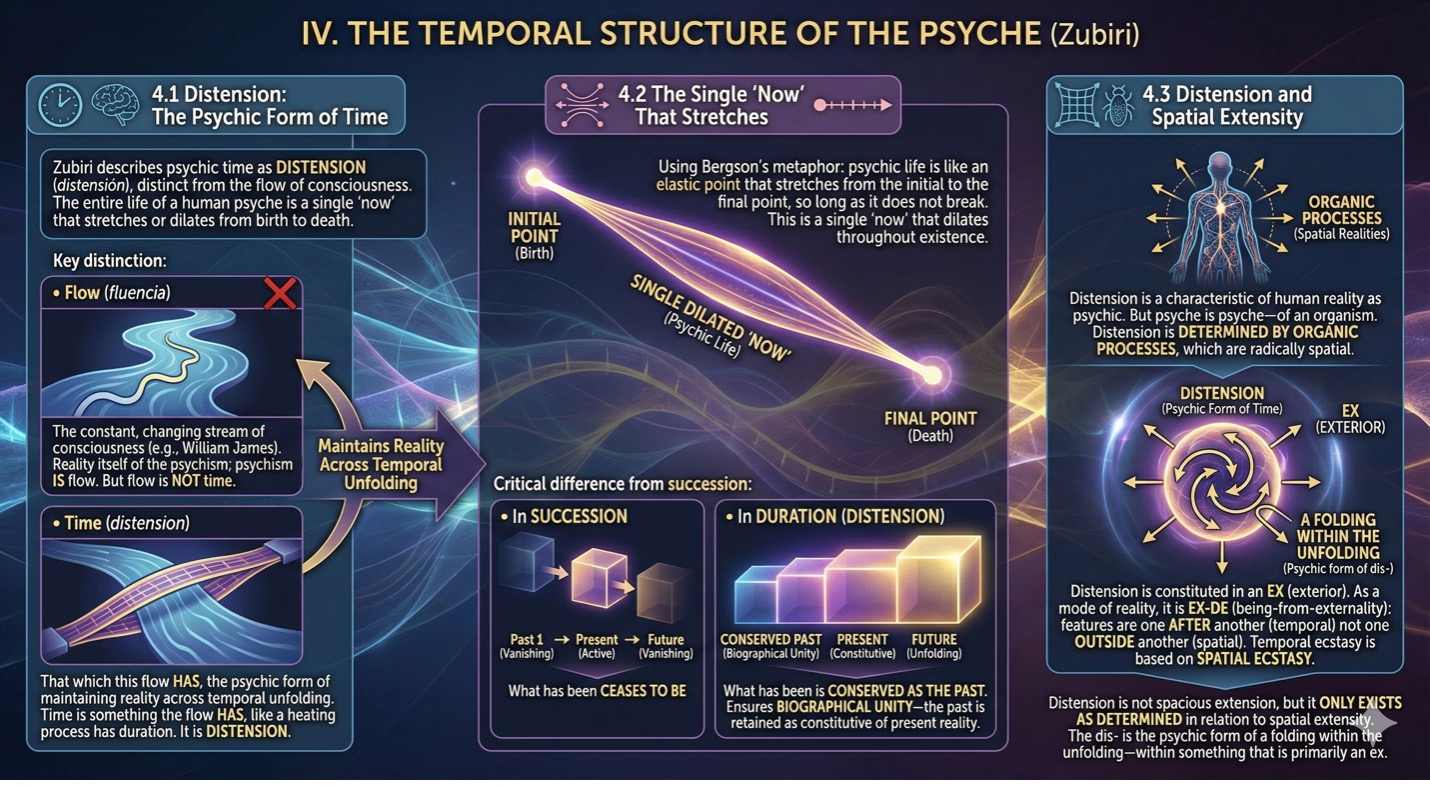
Fig 4: Temporality — Biographical integration with cosmic time.
Faith, Transcendence, and the Open Equation
Beyond the psychosomatic architecture described above, Zubiri's anthropology includes one further structural feature of human reality — a concept he called religation: the human being's constitutive openness to what grounds existence itself. For Zubiri, this is not a religious belief added onto the person from outside, but a structural feature of human reality: we are beings who cannot help but orient toward something that transcends the immediate. He described this as the human being being "religated" to the power of the real — whether that power is named God, Being, Nature, or left unnamed.
The BZE does not require any particular metaphysical commitment. It is a mathematical model, not a belief. At this stage, it's a hypothesis. But the conditional bar in the equation — the | that reads "conditioned by" — is philosophically open. The environmental field that shapes who you are includes everything that structures your existence: economic conditions, relational safety, cultural belonging, and, for many people, a transcendent framework of meaning that orients their biography.
For people of faith, the telic drive that powers behavioural agency may be experienced as vocation, calling, or response to the divine rather than self-generated purpose. The framework treats this identically — and the empirical literature supports it: intrinsic religious motivation is associated with higher purpose, better psychological integration, and greater resilience under adversity. The framework's openness here is not a concession; it reflects Zubiri's own insistence that the human psyche cannot be fully understood without accounting for its constitutive orientation toward what transcends it.
Why This Matters — and What the Framework Offers
Current approaches often:
- Fragment the person: Treat mental and physical as separate domains.
- Leave psyche vague: Avoid the term or treat it as separable from biology.
- Underweight context: Struggle when the environment is structurally hostile.
- Lack integration: Psychosomatics viewed through illness rather than wholeness.
The framework offers:
- → A conceptual lens for psychosomatic integration
- → Structural attention to environmental context
- → Reflective considerations for clinical thinking
- → Respect for both biology and biography
The Biozygotic Aims
The framework aims to articulate psyche as a candidate natural object whose structural dynamics can be approached through existing measures, think about mind-body unity philosophically and schematically without dualism or reductionism, attend to structural violence through the lens of biological weathering, inform clinical reflection through attention to the differential supports and strains in each person's situation, and respect human dignity by preserving agency and irreducible uncertainty. These are aims and directions of inquiry; their full realization depends on continued collaboration with researchers, mathematicians, and clinicians.
Begin Your Reflection
Ready to consider where your psychosomatic unity currently stands?
Try the Reflection Tool